
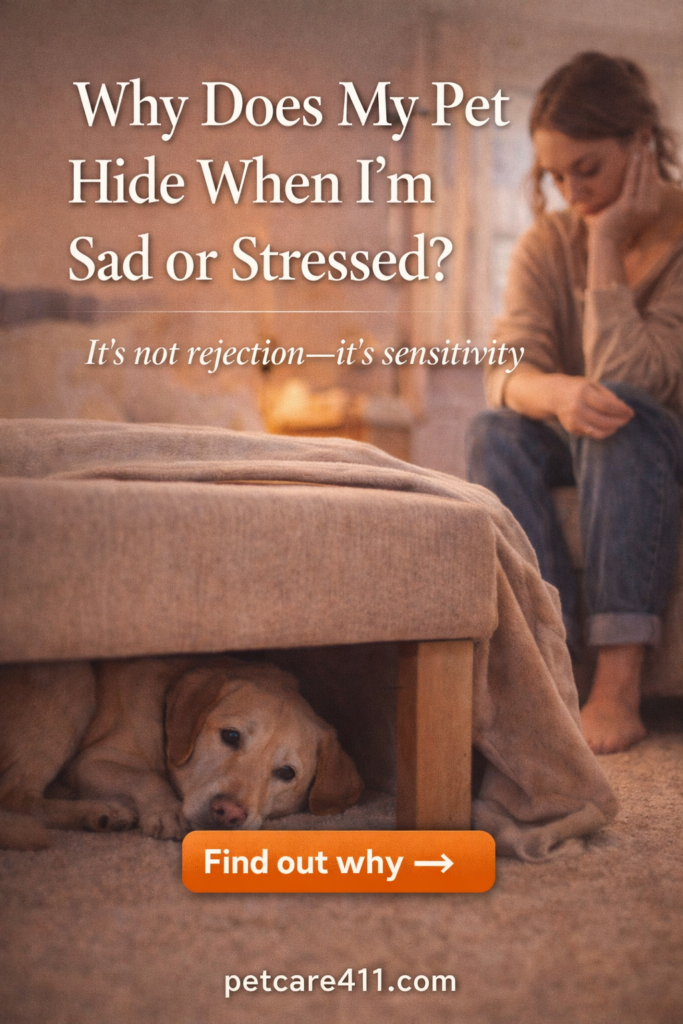
You’re having a rough day.
You feel overwhelmed, anxious, or upset.
And suddenly… your pet disappears.
If you’ve ever wondered why your dog or cat seems to hide, withdraw, or avoid you when you’re sad or stressed, you’re not imagining it—and you’re not alone.
This behavior can feel hurtful at first, but in most cases, it has nothing to do with rejection. In fact, it often means your pet is reacting to your emotions in ways that are deeply instinctual.
Let’s break down what’s really happening.
1. Pets Can Sense Emotional Changes—Even When You Say Nothing
Dogs and cats are incredibly sensitive to subtle cues, including:
- Changes in your tone of voice
- Body language and posture
- Facial expressions
- Breathing patterns
- Stress-related scents (like cortisol)
Even if you’re trying to “act normal,” your pet may already know something is off.
When emotions shift suddenly, some pets respond by creating distance, especially if they’re unsure how to interpret the change.
2. Stress Signals Can Feel Confusing or Threatening
From your pet’s perspective, stress looks like unpredictability.
You might:
- Move differently
- Speak less (or more)
- Cry
- Be unusually still or tense
- React slower or faster than usual
For sensitive pets, this can trigger a natural response: “Something is different—better give space.”
This doesn’t mean they don’t care. It means they’re trying to keep themselves regulated.
3. Some Pets Avoid Stress to Self-Soothe
Just like humans, pets have different coping styles.
When faced with emotional tension, some animals:
- Seek comfort
- Become clingy
- Watch closely from a distance
Others cope by:
- Hiding
- Sleeping
- Retreating to quiet spaces
Hiding can be a form of self-calming, not avoidance of you personally.
4. Past Experiences Can Shape Their Response
If your pet has ever experienced:
- Loud arguments
- Crying followed by chaos
- Stressful events tied to emotional moments
They may have learned that strong emotions = potential danger or disruption.
In these cases, hiding is a learned protective behavior—not a lack of bond.
This is especially common in:
- Rescue animals
- Pets with past trauma
- Highly sensitive breeds or personalities
5. Cats and Dogs Respond Differently
Dogs
Some dogs become extra attentive when you’re upset. Others become cautious and withdraw if they sense emotional instability.
Dogs that hide when you’re stressed are often:
- Sensitive
- Conflict-avoidant
- Easily overwhelmed by emotional shifts
Cats
Cats are especially tuned into emotional energy and environment changes.
When a cat hides during emotional moments, it’s often because:
- The energy feels “off”
- They prefer calm and predictability
- They’re regulating themselves
This is very normal feline behavior.
When Should You Be Concerned?
Occasional hiding during emotional moments is normal.
But consider checking with a vet or behaviorist if your pet:
- Hides frequently or excessively
- Avoids you even when calm
- Stops eating or interacting
- Shows signs of anxiety or fear
- Suddenly changes behavior with no clear reason
Persistent withdrawal can sometimes signal anxiety, stress sensitivity, or underlying health issues.
How to Help Your Pet Feel Safer When You’re Stressed
You don’t need to suppress your emotions—but small adjustments can help:
- Speak softly and calmly when possible
- Maintain routines (feeding, walks, play)
- Avoid forcing interaction
- Let them approach you on their terms
- Offer calm reassurance without pressure
Often, giving space actually helps pets return sooner.
The Bottom Line
If your pet hides when you’re sad or stressed, it doesn’t mean they don’t love you.
It usually means they are:
- Sensitive to emotional energy
- Trying to self-regulate
- Responding instinctively to change
- Protecting their own sense of calm
In many cases, once the emotional storm passes, they come right back—quietly checking in, just in their own way.