
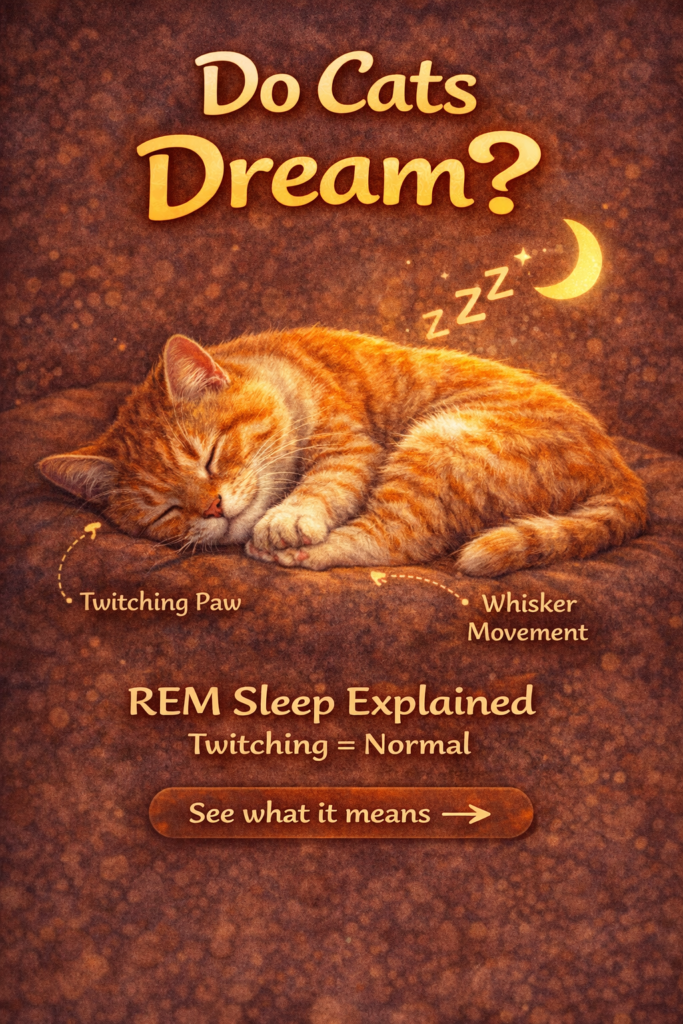
What Your Sleeping Cat’s Twitches, Whisker Flicks, and Tiny Noises Really Mean
If you’ve ever watched your cat sleeping and noticed their paws twitching, whiskers quivering, or little chirps escaping their mouth, you’ve probably wondered:
Do cats dream?
As a long-time cat owner and feline behavior enthusiast, I can tell you this with confidence:
Yes — cats absolutely dream.
And not only do they dream, but their dream cycles are surprisingly similar to ours.
Let’s dive into the science behind feline sleep, what your cat might be dreaming about, and when those sleep movements are completely normal — or worth a closer look.
Do Cats Experience REM Sleep?
Yes, they do.
Cats go through different stages of sleep, including:
- Light sleep
- Deep sleep
- REM sleep (Rapid Eye Movement)
REM sleep is the stage associated with dreaming in humans.
During REM:
- Brain activity increases
- Eyes move behind closed lids
- Muscles partially relax
- The body may twitch
This is exactly what we observe in cats.
In fact, researchers have studied feline brain activity and found that cats display the same neurological patterns during REM sleep that humans do when dreaming.
What Does Cat Dreaming Look Like?
If your cat is dreaming, you might notice:
- Paw twitching
- Tail flicking
- Whisker movements
- Soft chirps or meows
- Rapid breathing changes
- Ear flicks
Sometimes it looks like they’re running in place. Other times, they may make tiny hunting sounds.
From years of watching my own cats, I’ve noticed that the more active the twitching, the deeper the REM cycle seems to be.
And no — it’s not a seizure. It’s normal REM sleep.
What Do Cats Dream About?
While we can’t ask them directly, we can make educated guesses based on brain activity and behavior patterns.
Cats likely dream about:
- Hunting
- Playing
- Chasing prey
- Exploring territory
- Interacting with familiar people or animals
Kittens may dream about:
- Nursing
- Playing with littermates
- Early learning experiences
Senior cats may dream about:
- Familiar routines
- Past environments
- Daily interactions
Because cats rely heavily on instinct and repetition, their dreams are likely rooted in their daily experiences — just like ours.
How Long Do Cats Spend Dreaming?
Cats sleep 12 to 16 hours per day, sometimes more.
However, not all sleep is deep sleep.
Most feline sleep is light sleep, meaning:
- They’re resting
- They can wake quickly
- They remain alert to their surroundings
REM sleep only makes up about 20–25% of total sleep time in adult cats.
Kittens, however, spend much more time in REM sleep. This supports brain development and learning.
Do Kittens Dream More Than Adult Cats?
Yes.
Kittens can sleep up to 20 hours per day, and a large portion of that time is REM sleep.
This stage is essential for:
- Neural development
- Motor skill learning
- Memory consolidation
If you’ve ever seen a tiny kitten “running” in its sleep, that’s likely REM dreaming.
Should You Wake a Dreaming Cat?
As a rule — no.
Even if your cat is twitching or making noises, it’s best to let them finish their sleep cycle.
Waking a cat during REM can:
- Startle them
- Cause confusion
- Trigger defensive reflexes
Cats can react quickly if startled mid-dream.
If your cat appears distressed, wait for them to wake naturally.
Is It Ever Not Normal?
Dream twitching is normal.
However, consult a veterinarian if you notice:
- Violent or prolonged body shaking
- Stiffness rather than twitching
- Loss of bladder control
- Disorientation after waking
- Repeated episodes of uncontrolled movement
These symptoms may indicate something other than dreaming, such as a neurological issue.
But mild twitching? Completely normal.
Why Cats Need So Much Sleep
Understanding dreaming means understanding feline sleep patterns overall.
Cats evolved as ambush predators, which means they conserve energy during rest so they can unleash explosive bursts of movement when hunting.
Sleep allows them to:
- Repair muscles
- Regulate hormones
- Strengthen memory
- Maintain immune health
REM sleep specifically helps:
- Process learned experiences
- Reinforce instincts
- Improve coordination
So when your cat is dreaming, they’re not just resting — they’re maintaining brain health.
Do Cats Have Nightmares?
Possibly.
Just like humans, animals likely replay emotional experiences.
If your cat:
- Wakes suddenly
- Seems startled
- Repositions quickly
…it may have experienced a dream shift.
However, cats don’t appear to dwell on dreams after waking the way humans do. They typically shake it off and move on quickly.
Fun Fact: Brain Studies in Cats
In controlled studies, scientists observed that when the part of the brain that prevents physical movement during REM sleep was temporarily disabled, cats physically acted out dream sequences — stalking and pouncing while still asleep.
This strongly supports the conclusion that cats dream about hunting behaviors.
Final Answer: Do Cats Dream?
Yes — cats dream.
They experience REM sleep just like humans, and their twitching paws, flicking tails, and tiny vocalizations are signs of active dream cycles.
They likely dream about:
- Hunting
- Playing
- Exploring
- Familiar people
- Daily routines
Watching a cat dream is actually a beautiful reminder that their minds are active, processing, and replaying their world — even while they’re curled up in a sunny spot.