
A Complete Guide to Feline Gestation, Signs, Stages, and Care
If you suspect your cat may be pregnant—or you’re planning to breed cats responsibly—you’re probably asking:
How long does a cat’s pregnancy last?
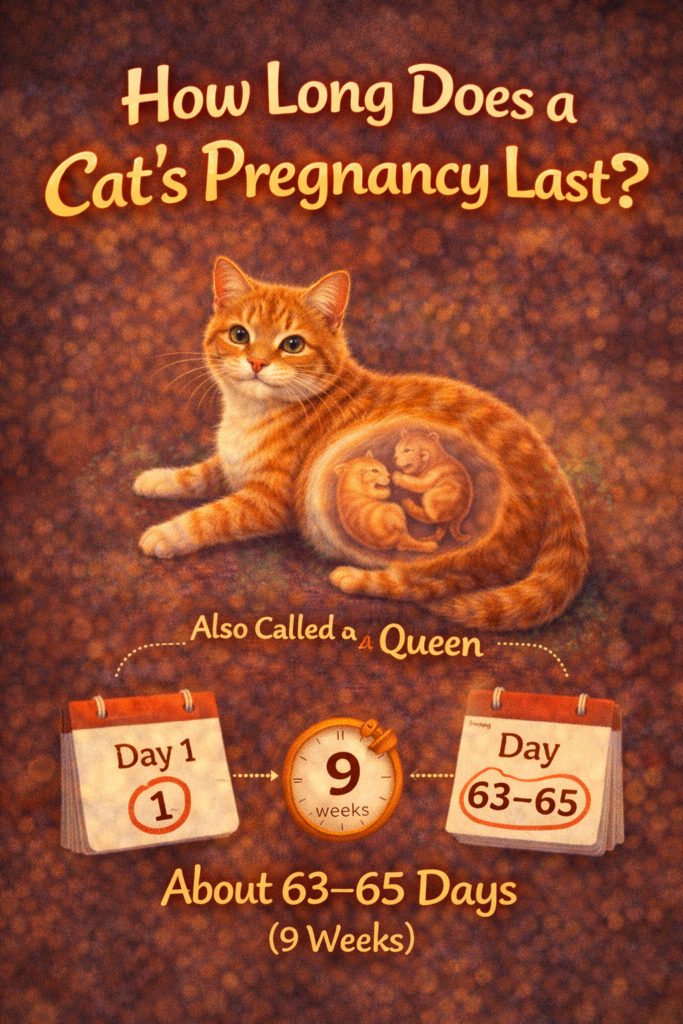
On average, a cat’s pregnancy (called gestation) lasts 63 to 65 days, or about 9 weeks. However, some pregnancies may be slightly shorter or longer depending on the individual cat, litter size, and overall health.
In this guide, we’ll cover:
- How long cats are pregnant
- Early signs of feline pregnancy
- A week-by-week breakdown of cat gestation
- How to care for a pregnant cat
- Signs labor is approaching
- When to contact a veterinarian
The Short Answer: How Long Is a Cat Pregnant?
A typical cat pregnancy lasts:
- 63–65 days (about 9 weeks)
Some cats may give birth as early as 58 days or as late as 70 days, but pregnancies outside this range should be monitored closely by a veterinarian.
A pregnant cat is referred to as a queen.
When Can Cats Get Pregnant?
Cats reach sexual maturity surprisingly early.
Most cats can become pregnant:
- As young as 4–6 months old
- During heat cycles that occur every 2–3 weeks
Cats are induced ovulators, meaning ovulation occurs after mating. This makes pregnancy very likely if mating happens during heat.
Early Signs of Cat Pregnancy (Weeks 1–3)
In the first few weeks, pregnancy signs can be subtle.
Common early signs include:
- Increased appetite
- Slight weight gain
- Behavioral changes (more affectionate or more withdrawn)
- Pink, enlarged nipples (“pinking up”) around 2–3 weeks
At this stage, it can be difficult to confirm pregnancy without veterinary examination.
Week-by-Week Cat Pregnancy Timeline
Weeks 1–2: Fertilization and Implantation
- Eggs are fertilized after mating
- Embryos implant in the uterus
- No visible physical changes yet
Weeks 3–4: Early Development
- Nipples become pink and swollen
- Mild morning sickness may occur
- Appetite may increase
- Embryos begin forming organs
A vet may confirm pregnancy via ultrasound around week 3–4.
Weeks 5–6: Visible Changes
- Belly starts to round
- Noticeable weight gain
- Increased appetite (up to 50% more food)
- Kittens develop skeletal structure
This is when pregnancy becomes obvious to most owners.
Weeks 7–8: Nesting Behavior
- Queen may seek quiet, secluded areas
- Decreased activity levels
- Increased grooming
- Kittens are fully formed
You may even feel kittens move gently in the abdomen.
Week 9: Labor Preparation
- Restlessness
- Vocalization
- Loss of appetite
- Milk production
- Temperature drop below 100°F (37.8°C)
Labor usually begins within 24 hours of these signs.
How Many Kittens Do Cats Have?
The average litter size is:
- 3–5 kittens
However, litters can range from:
- 1 to 9 kittens
First-time mothers often have smaller litters.
How to Care for a Pregnant Cat
1. Provide Proper Nutrition 🍽️
Switch to:
- High-quality kitten food during pregnancy
- Increased portions gradually
Kitten food provides the extra calories and nutrients needed for fetal development.
2. Limit Stress
Keep your pregnant cat:
- Indoors
- Away from loud noises
- Separated from aggressive pets
Stress can negatively impact pregnancy.
3. Avoid Handling the Belly
Do not press or squeeze the abdomen.
Gentle petting is fine, but excessive handling can cause discomfort.
4. Prepare a Nesting Area 🧺
Create a quiet space with:
- A box or enclosed bed
- Soft blankets or towels
- Low traffic and minimal noise
Your cat may choose her own spot—let her decide if possible.
Signs a Cat Is About to Give Birth
Watch for:
- Nesting behavior
- Panting or pacing
- Repeated grooming of the genital area
- Vocalizing
- Visible contractions
Labor typically progresses within hours once contractions begin.
How Long Does Cat Labor Last?
Labor can last:
- 2 to 12 hours
- Occasionally up to 24 hours
Kittens are usually born:
- Every 10–60 minutes
If your cat strains for more than 30 minutes without producing a kitten, contact a veterinarian immediately.
When to Call a Vet During Pregnancy or Labor
Seek veterinary care if:
- Pregnancy exceeds 70 days
- The queen appears lethargic or distressed
- There is foul-smelling discharge
- Prolonged labor occurs
- A kitten becomes stuck
Prompt care can save both the mother and kittens.
Can Cats Get Pregnant Again Quickly?
Yes. Cats can go into heat:
- As soon as 2–3 weeks after giving birth
This is why spaying is strongly recommended once kittens are weaned.
Final Answer: How Long Does a Cat’s Pregnancy Last?
A cat’s pregnancy typically lasts 63–65 days, or about 9 weeks.
During this time, the queen undergoes significant physical and hormonal changes to support her developing kittens. With proper nutrition, a calm environment, and attentive care, most cats give birth naturally and without complications.
Understanding feline pregnancy helps owners:
- Prepare for labor
- Support maternal health
- Ensure healthy kittens