
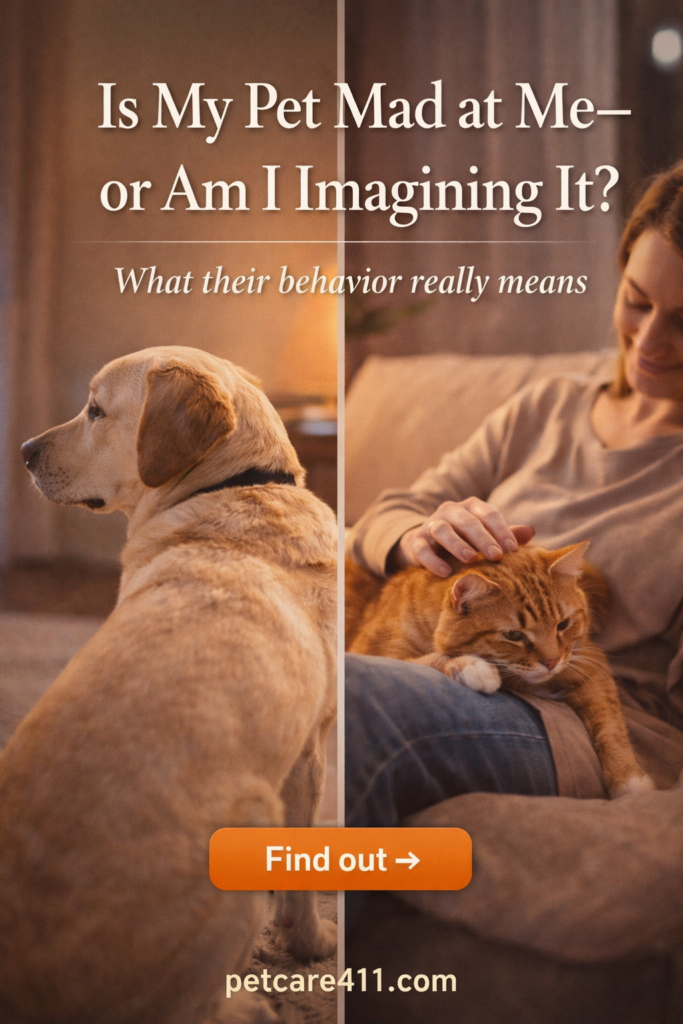
Your pet won’t come when you call.
They avoid eye contact.
They act distant… maybe even annoyed.
And suddenly you’re wondering:
Did I do something wrong?
Before you spiral into guilt, let’s clear something up—pets do express emotions, but they don’t experience anger the way humans do. What looks like “being mad” is usually something else entirely.
Let’s break down what’s really happening.
Can Pets Actually Be “Mad”?
Short answer: not in the human sense.
Pets don’t hold grudges or replay past events emotionally. They live very much in the present. However, they do experience:
- Stress
- Fear
- Confusion
- Overstimulation
- Discomfort
Those emotions can absolutely change how they act toward you—and that’s where the confusion comes in.
Common Reasons Your Pet Seems “Mad”
1. They’re Confused by a Recent Change
Pets thrive on routine. Even small disruptions can cause temporary withdrawal.
Examples:
- New schedule
- Travel or boarding
- New pet or person
- Rearranged furniture
- Different feeding times
To your pet, change = uncertainty, not betrayal.
2. They’re Overstimulated or Need Space
Dogs and cats both have limits—even with people they love.
Signs of overstimulation include:
- Turning their head away
- Leaving the room
- Tail flicking (especially cats)
- Refusing interaction
This isn’t anger. It’s communication.
3. They’re Responding to Tone or Body Language
Pets are incredibly sensitive to:
- Raised voices
- Tension
- Stress
- Emotional shifts
If you’re upset—even about something unrelated—your pet may distance themselves because they sense something is “off.”
4. They Associate You With an Unpleasant Experience
This one feels personal, but it’s actually very logical.
Your pet may temporarily avoid you if you recently:
- Took them to the vet
- Gave medication
- Trimmed nails
- Gave a bath
- Enforced a boundary
They’re not mad—they’re making a short-term association.
The good news? These associations fade quickly with positive interactions.
5. Pain or Discomfort Is Changing Their Behavior
One of the most overlooked causes of “attitude changes” is physical discomfort.
If your pet is:
- Suddenly distant
- Less affectionate
- Avoiding touch
- Acting irritable
Pain could be the reason—not emotion.
This is especially important for senior pets or sudden behavior changes.
Signs Your Pet Is Not Mad at You
Here’s what usually means you’re imagining it:
- They still eat normally
- They relax in the same room as you
- They follow you quietly
- They accept treats
- They return to normal behavior within hours or days
Real emotional damage doesn’t resolve that quickly—stress responses do.
When Should You Pay Attention?
It’s worth digging deeper if your pet:
- Avoids you for days
- Shows fear or aggression
- Stops eating
- Hides excessively
- Has other physical symptoms
In those cases, a vet check or behavior consult is a smart move—not because they’re mad, but because something may be wrong.
How to Rebuild Connection (Without Forcing It)
If you’re feeling disconnected, try this:
- Stick to routines
- Use calm, neutral tones
- Offer space—don’t chase affection
- Use positive reinforcement (treats, play)
- Keep interactions predictable
Pets reconnect naturally when they feel safe and understood.
The Bottom Line
Your pet isn’t secretly angry with you.
What you’re seeing is usually:
- Stress
- Confusion
- Overstimulation
- Discomfort
- Or a temporary association
The bond you have doesn’t disappear overnight—and most of the time, reassurance and consistency are all it takes to bring things back to normal.