
If you’re researching leopard gecko care, you’re probably trying to avoid beginner mistakes — and that’s smart.
Leopard geckos are hardy reptiles, but they are extremely dependent on correct environmental conditions. Most appetite problems, shedding issues, stress behaviors, and long-term health complications are caused by:
- Improper heating
- Incorrect tank size
- Poor humidity control
- Inconsistent supplementation
This complete leopard gecko care guide walks you through everything you need to properly set up, maintain, and troubleshoot a healthy enclosure.
If you’re brand new, start with the full setup blueprint here:
👉 Leopard Gecko Setup Checklist (Beginner Safe)
If you’re troubleshooting a problem, you’ll find solutions linked throughout this guide.
Bookmark this page — it’s your central resource hub.
Tank Size & Enclosure Setup
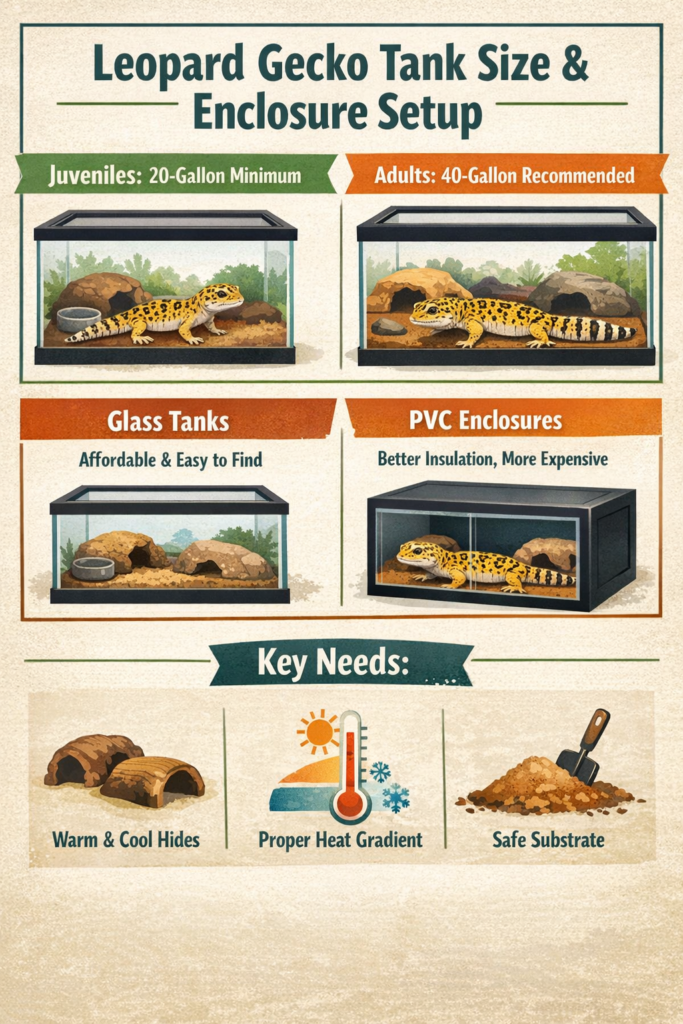
One of the most common outdated recommendations still floating around is that a 10-gallon tank is enough for an adult leopard gecko.
It isn’t.
What Size Tank Does a Leopard Gecko Need?
- Juveniles: 20-gallon long minimum
- Adults: 40-gallon breeder recommended
The reason isn’t just “space.”
Leopard geckos need a thermal gradient — meaning one side of the enclosure must be warmer than the other. A larger enclosure allows proper thermoregulation, which directly affects digestion and immune function.
If you want a detailed breakdown of tank dimensions and layout examples:
👉 Leopard Gecko Tank Size Guide (20 vs 40 Gallon Comparison)
Glass vs PVC Enclosures
Both options work.
Glass Tanks
- Budget-friendly
- Easy to source
- Good visibility
- Require room temperature stability
PVC Enclosures
- Better insulation
- More stable temps
- Higher upfront cost
If you’re choosing your first enclosure, I recommend reading:
👉 Best Leopard Gecko Tanks for Beginners →
Heating & Temperature (Most Important Section)
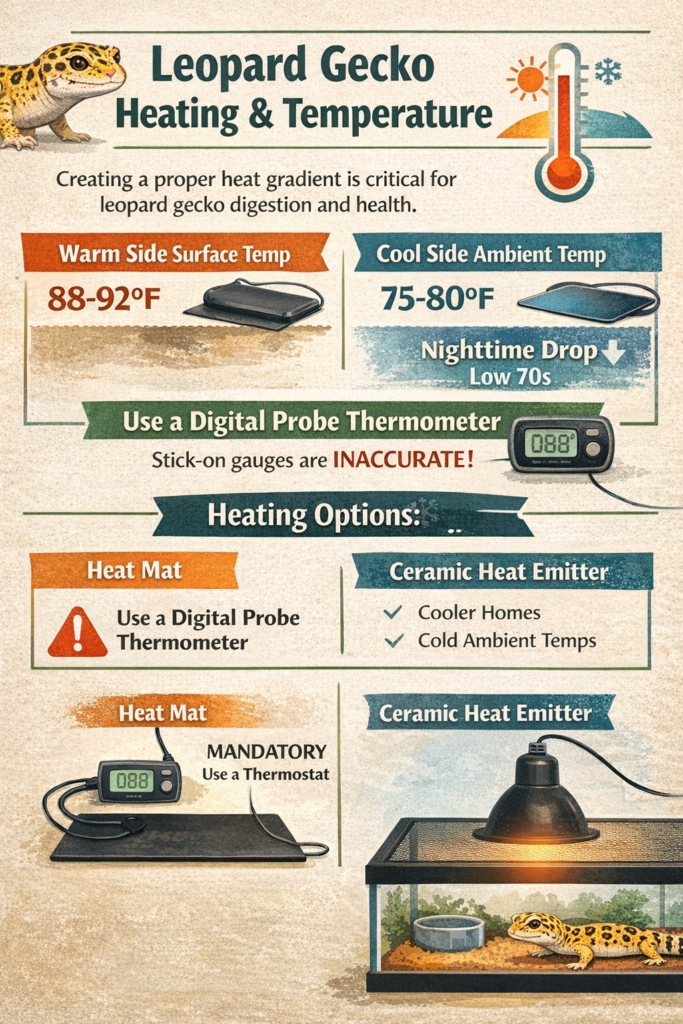
If there is one area to get right, it’s heating.
Improper temperature is the #1 reason leopard geckos:
- Stop eating
- Become lethargic
- Struggle to shed
- Develop long-term health issues
Ideal Temperature Range
- Warm side surface: 88–92°F
- Cool side ambient: 75–80°F
- Nighttime drop: Low 70s is safe
Surface temperature must be measured with a digital probe thermometer, not a stick-on gauge.
If you need help dialing in temperatures:
👉 Leopard Gecko Heating Setup Guide (Exact Numbers + Layout)
Heat Mats vs Overhead Heating
Most leopard gecko setups use under-tank heat mats to provide belly heat.
However:
Heat mats MUST be connected to a thermostat.
Without one, temperatures can exceed 120°F.
For a breakdown of safe heat sources:
👉 Best Heat Mats for Leopard Geckos (Safe Options Compared) →
And for temperature control:
👉 Best Thermostats for Leopard Geckos (Why You Need One) →
Lighting & UVB for Leopard Gecko Care
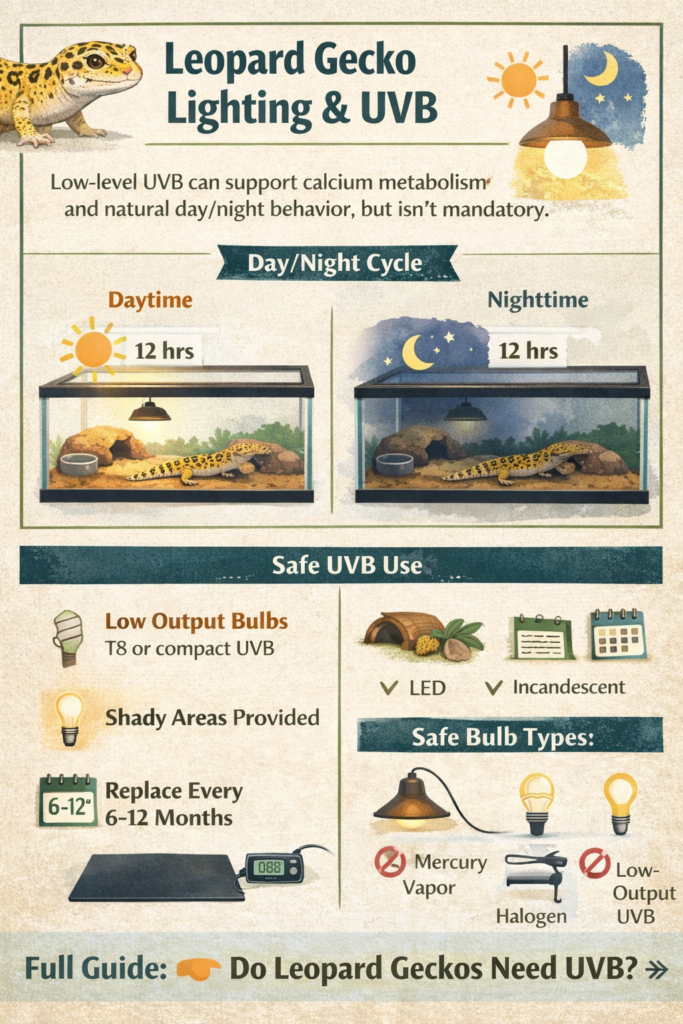
Leopard geckos are crepuscular — active at dawn and dusk — which means they don’t require intense UVB like bearded dragons.
However, low-output UVB may support:
- Bone health
- Calcium metabolism
- Natural behaviors
Some keepers rely entirely on calcium + D3 supplementation instead.
If you’re unsure which route to take:
👉 Do Leopard Geckos Need UVB? (Full Breakdown) →
Substrate Guide for Leopard Gecko Care
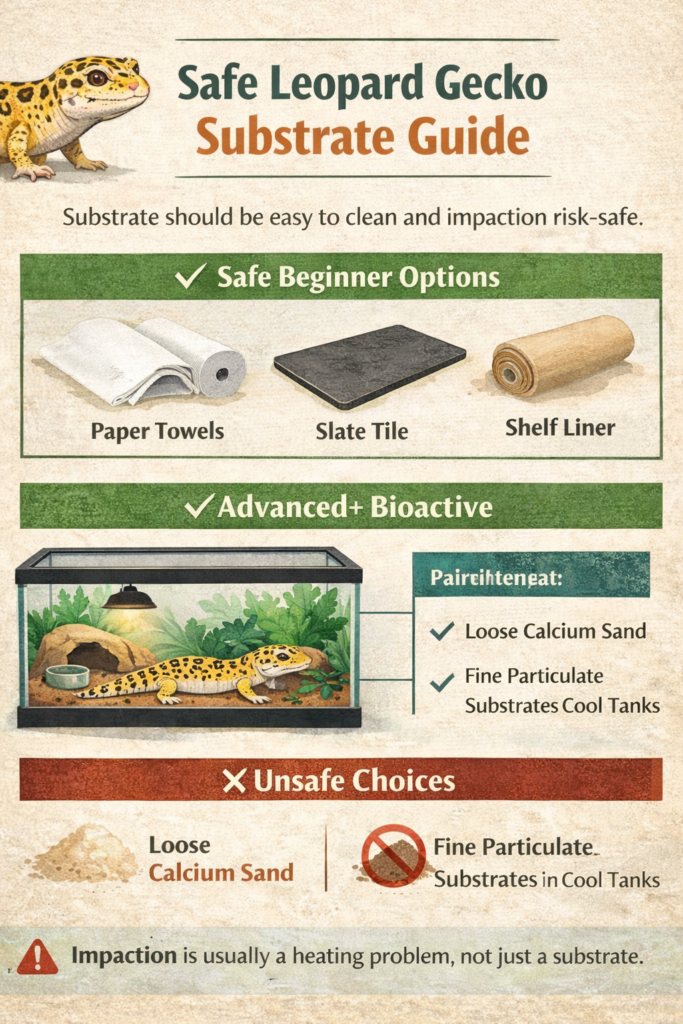
Substrate affects hygiene, shedding, and impaction risk.
Safe Beginner Options
- Paper towels
- Slate tile
- Non-adhesive shelf liner
Advanced Options
- Bioactive substrate blends
What to Avoid
- Loose calcium sand
- Fine particulate substrates in poorly heated tanks
Impaction is often caused by incorrect heating, not just substrate.
If you’re unsure which option is safest:
👉 Best Substrate for Leopard Geckos (Safe vs Risky Choices) →
Feeding & Nutrition for Leopard Gecko Care
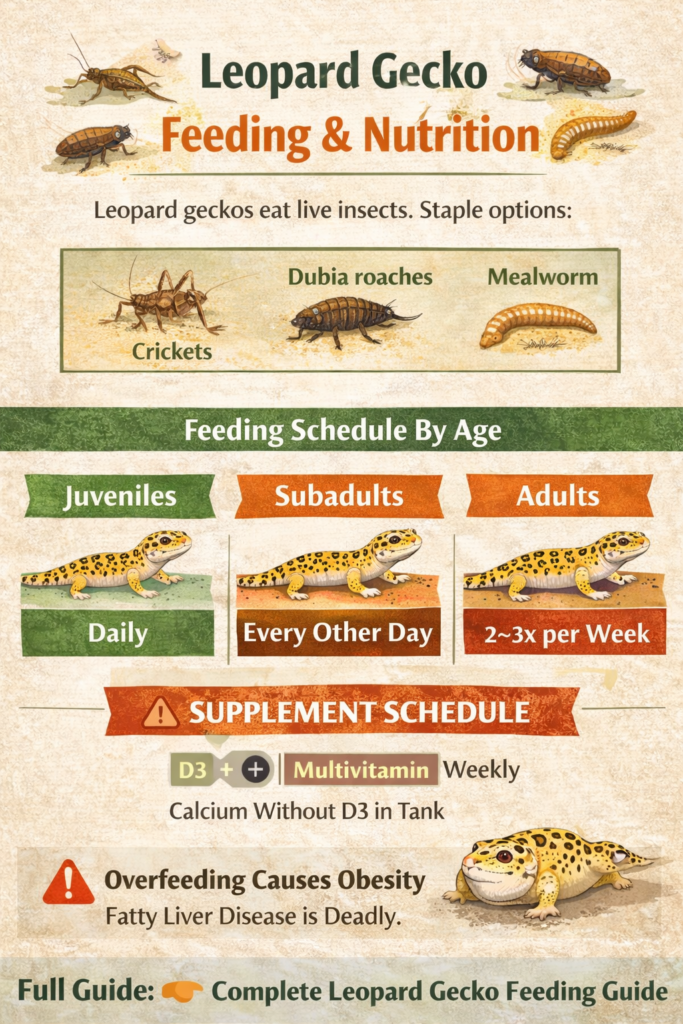
Leopard geckos are strict insectivores.
Their diet must be balanced and supplemented properly.
What Do Leopard Geckos Eat?
Staple feeders include:
- Crickets
- Dubia roaches
- Mealworms
Variety improves nutrition.
For a full feeding breakdown:
👉 Complete Leopard Gecko Feeding Guide (By Age) →
Feeding Schedule
Juveniles:
- Daily
Subadults:
- Every other day
Adults:
- 2–3 times per week
Overfeeding can lead to obesity and fatty liver disease.
Supplements & Calcium
Metabolic bone disease (MBD) is preventable.
Best practice:
- Calcium without D3 available in enclosure
- Calcium with D3 dusted 1–2 times weekly
- Multivitamin weekly
For exact dosing schedules:
👉 Leopard Gecko Supplement Schedule (Printable Chart) →
Common Leopard Gecko Health Problems
This is where most search traffic lands.
Let’s walk through the most common issues.
Leopard Gecko Not Eating
This is the most searched leopard gecko problem.
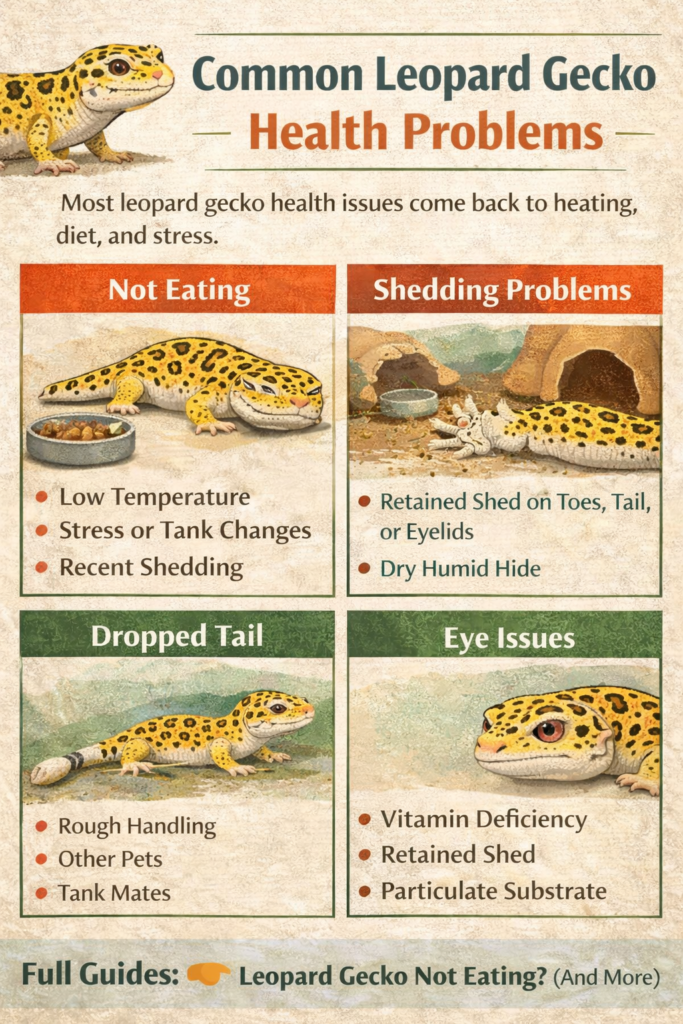
Common causes:
- Low surface temperature
- Stress from enclosure changes
- Shedding cycle
- Seasonal slowdown
Before panicking, check heating first.
Full troubleshooting guide:
👉 Leopard Gecko Not Eating? Fix It Fast →
Shedding Problems (Stuck Shed)
Retained shed commonly sticks to:
- Toes
- Tail tip
- Eyelids
Solution:
- Provide humid hide
- Raise localized humidity
- Gentle soak if needed
Never forcibly remove dry shed.
Detailed guide:
👉 Leopard Gecko Shedding Problems (Safe Removal Guide) →
Tail Dropping
Tail loss is usually stress-related.
Common triggers:
- Rough handling
- Predator stress
- Tank mates
- Sudden environmental changes
Recovery and regrowth explained here:
👉 Why Leopard Geckos Drop Their Tail (Prevention + Regrowth) →
Eye Problems
Symptoms include:
- Squinting
- Swelling
- Cloudiness
Often caused by:
- Vitamin A deficiency
- Retained shed
- Substrate irritation
Early treatment is critical.
👉 Leopard Gecko Eye Problems (Causes + Treatment) →
Leopard Gecko Care Essential Equipment Checklist
A properly equipped enclosure prevents 90% of health problems.
Minimum Setup:
- 40-gallon tank
- Heat mat
- Digital thermostat
- Digital probe thermometer
- 3 hides (warm, cool, humid)
- Safe substrate
- Calcium dish
If you want the full printable checklist:
👉 Download the Free Leopard Gecko Setup Guide →
Recommended Equipment
For detailed comparisons, visit:
- 👉 Best Heat Mats for Leopard Geckos
- 👉 Best Thermostats for Leopard Geckos
- 👉 Best Leopard Gecko Hides
- 👉 Complete Beginner Setup Kits
These comparison posts help you avoid wasting money on unsafe equipment.
Free Resources
To make setup easier, I recommend starting here:
👉 Download the Free Guide →
Includes:
- Temperature chart
- Feeding tracker
- Supplement schedule
- Emergency warning signs
Frequently Asked Questions
What temperature should a leopard gecko tank be?
Warm side surface: 88–92°F
Cool side: 75–80°F
Use a digital probe thermometer for accuracy.
Do leopard geckos need UVB?
Not mandatory but beneficial at low output levels.
Full explanation here:
👉 Do Leopard Geckos Need UVB? →
How long do leopard geckos live?
With proper care, 15–20 years.
They are long-term commitments.
Is sand safe?
For beginners, avoid loose sand.
Full breakdown here:
👉 Best Substrate for Leopard Geckos →
Final Thoughts
Leopard geckos thrive when their environment is controlled precisely.
Most health issues trace back to:
- Incorrect heating
- Improper supplementation
- Inadequate enclosure size
- Stress
If you want to set things up correctly the first time:
👉 Start With the Leopard Gecko Setup Checklist →