
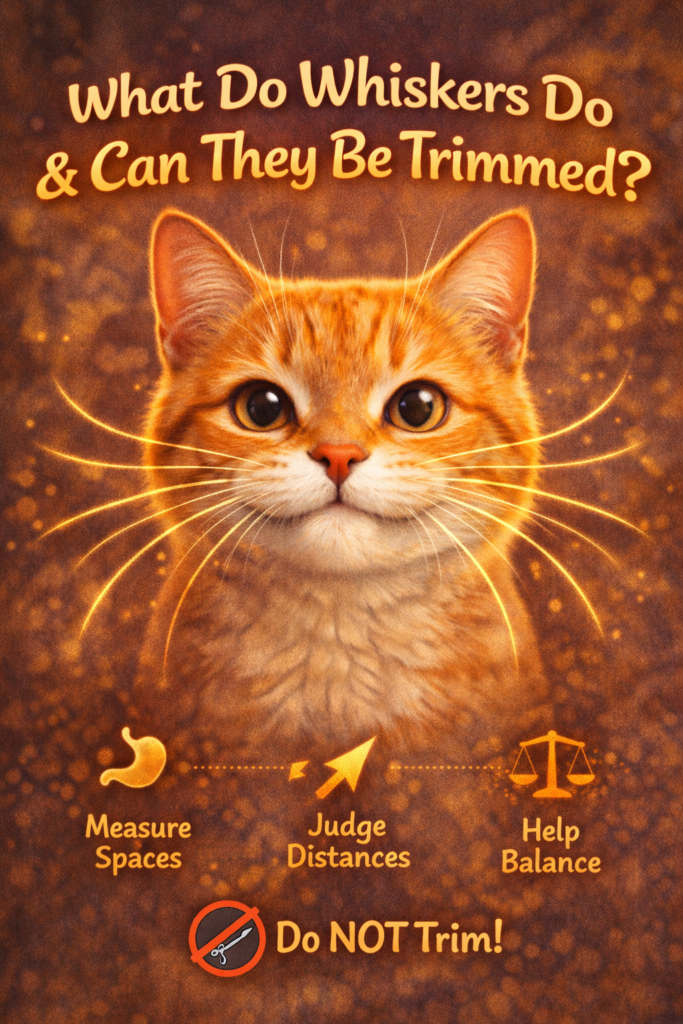
The Sensory Superpower of Whiskers (and Why They Should Never Be Cut)
Cat whiskers may look like simple facial hairs, but they are actually one of the most important sensory tools a cat has. Despite this, many cat owners still wonder:
What do whiskers do?
And can cat whiskers be trimmed?
The short answer:
👉 Whiskers are highly sensitive sensory organs
👉 They help cats navigate the world
👉 They should never be cut or trimmed
In this article, we’ll explain:
- What whiskers really are
- How cats use them to measure space and detect movement
- Why whiskers are as wide as a cat’s body
- What happens if whiskers are cut
- Signs of whisker stress or damage
- How to protect your cat’s whiskers properly
What Are Cat Whiskers, Really?
Cat whiskers are not ordinary hairs.
They are called vibrissae, a specialized type of hair that is:
- Thicker than regular fur
- Deeply rooted in muscle and nerve tissue
- Packed with sensory receptors
Each whisker is connected to:
- Blood vessels
- Nerve endings
- Sensory cells
This allows whiskers to transmit detailed information directly to the cat’s brain.
📌 In simple terms: whiskers are touch sensors, not decoration.
Where Are a Cat’s Whiskers Located?
Most people notice whiskers on the face, but cats actually have whiskers in several places:
- Above the eyes (superciliary whiskers)
- On the cheeks
- On the upper lip
- On the back of the front legs (carpal whiskers)
Each set plays a different role in helping cats navigate and hunt.
What Do Whiskers Do?
1. Help Cats Measure Gaps and Spaces 🐾
A cat’s whiskers are typically about the same width as their body.
This allows cats to:
- Determine if they can fit through a space
- Judge openings without entering them
- Avoid getting stuck
Before squeezing through a gap, a cat will often:
- Pause
- Angle their head
- Use whisker contact to assess clearance
If the whiskers touch both sides, the space is likely too narrow.
2. Detect Air Currents and Movement 🌬️
Whiskers are extremely sensitive to subtle changes in air movement.
They help cats:
- Detect approaching objects
- Sense prey movement in low light
- React quickly to sudden motion
This ability is especially important because:
- Cats hunt in low-light conditions
- Vision alone isn’t always enough
Whiskers give cats a form of “touch-based radar.”
3. Support Night Vision and Navigation
Cats don’t rely on sight alone — especially in the dark.
Whiskers help cats:
- Navigate unfamiliar spaces
- Avoid bumping into objects
- Judge distance and depth
Even in near darkness, whiskers help cats move confidently and quietly.
4. Assist With Hunting and Prey Capture
During hunting, whiskers:
- Track prey movement
- Help position the bite accurately
- Guide head and jaw placement
Once prey is close enough that it’s no longer visible, whiskers take over.
This is why whiskers are especially prominent around the mouth.
5. Communicate Emotional State 😺
Whisker position can signal mood.
- Forward-facing whiskers: curiosity, excitement, hunting focus
- Relaxed whiskers: calm, content
- Pulled-back or flattened whiskers: fear, stress, aggression
Learning to read whisker position helps you better understand your cat’s emotional state.
Can Cat Whiskers Be Trimmed?
❌ No — Cat Whiskers Should Never Be Cut
Trimming whiskers is not harmless grooming.
Cutting whiskers can:
- Disorient cats
- Cause stress or anxiety
- Impair balance and navigation
- Lead to collisions or hesitation
Cats rely on whiskers for spatial awareness. Removing them is like taking away a key sense.
📌 Even trimming “just a little” can interfere with sensory input.
What Happens If a Cat’s Whiskers Are Cut?
If whiskers are trimmed or damaged, cats may:
- Become hesitant or cautious
- Bump into objects
- Avoid jumping
- Seem confused or withdrawn
- Show signs of stress
While whiskers do grow back, the temporary loss can significantly affect confidence and movement.
Do Whiskers Ever Fall Out Naturally?
Yes — and this is normal.
Cats naturally shed whiskers occasionally, just like fur.
Normal whisker loss:
- Happens one whisker at a time
- Does not affect function
- Is replaced over time
⚠️ Sudden or excessive whisker loss may indicate:
- Skin issues
- Allergies
- Stress
- Trauma
What Is Whisker Fatigue?
Whisker fatigue occurs when a cat’s whiskers are overstimulated.
This can happen when:
- Food bowls are too narrow
- Whiskers constantly touch the sides while eating
Signs of whisker fatigue include:
- Pawing food out of bowls
- Leaving food uneaten
- Acting hesitant at mealtime
How to Prevent Whisker Fatigue
- Use wide, shallow food dishes
- Try flat plates
- Keep bowls clean and unobstructed
Why Are Whiskers White (or a Different Color)?
Whisker color varies and can be:
- White
- Black
- Matching fur color
- Mixed
Color has no impact on function — it’s purely genetic and cosmetic.
How to Protect Your Cat’s Whiskers
- Never trim or cut whiskers
- Use wide food and water bowls
- Avoid rough handling around the face
- Watch for signs of stress or damage
- Provide safe environments for exploration
Whiskers are essential equipment, not grooming accessories.
Final Answer: What Do Whiskers Do — and Can They Be Trimmed?
Cat whiskers are highly sensitive sensory hairs that help cats:
- Measure gaps and openings
- Detect air currents and movement
- Navigate in low light
- Hunt and capture prey
- Communicate emotional states
They are usually as wide as a cat’s body and are critical for spatial awareness.
Whiskers should never be trimmed.
Cutting them can cause confusion, stress, and impaired movement.
Respecting your cat’s whiskers means respecting one of their most important natural tools.The Sensory Superpower of Whiskers (and Why They Should Never Be Cut)
Cat whiskers may look like simple facial hairs, but they are actually one of the most important sensory tools a cat has. Despite this, many cat owners still wonder:
What do whiskers do?
And can cat whiskers be trimmed?
The short answer:
👉 Whiskers are highly sensitive sensory organs
👉 They help cats navigate the world
👉 They should never be cut or trimmed
In this article, we’ll explain:
- What whiskers really are
- How cats use them to measure space and detect movement
- Why whiskers are as wide as a cat’s body
- What happens if whiskers are cut
- Signs of whisker stress or damage
- How to protect your cat’s whiskers properly
What Are Cat Whiskers, Really?
Cat whiskers are not ordinary hairs.
They are called vibrissae, a specialized type of hair that is:
- Thicker than regular fur
- Deeply rooted in muscle and nerve tissue
- Packed with sensory receptors
Each whisker is connected to:
- Blood vessels
- Nerve endings
- Sensory cells
This allows whiskers to transmit detailed information directly to the cat’s brain.
📌 In simple terms: whiskers are touch sensors, not decoration.
Where Are a Cat’s Whiskers Located?
Most people notice whiskers on the face, but cats actually have whiskers in several places:
- Above the eyes (superciliary whiskers)
- On the cheeks
- On the upper lip
- On the back of the front legs (carpal whiskers)
Each set plays a different role in helping cats navigate and hunt.
What Do Whiskers Do?
1. Help Cats Measure Gaps and Spaces 🐾
A cat’s whiskers are typically about the same width as their body.
This allows cats to:
- Determine if they can fit through a space
- Judge openings without entering them
- Avoid getting stuck
Before squeezing through a gap, a cat will often:
- Pause
- Angle their head
- Use whisker contact to assess clearance
If the whiskers touch both sides, the space is likely too narrow.
2. Detect Air Currents and Movement 🌬️
Whiskers are extremely sensitive to subtle changes in air movement.
They help cats:
- Detect approaching objects
- Sense prey movement in low light
- React quickly to sudden motion
This ability is especially important because:
- Cats hunt in low-light conditions
- Vision alone isn’t always enough
Whiskers give cats a form of “touch-based radar.”
3. Support Night Vision and Navigation
Cats don’t rely on sight alone — especially in the dark.
Whiskers help cats:
- Navigate unfamiliar spaces
- Avoid bumping into objects
- Judge distance and depth
Even in near darkness, whiskers help cats move confidently and quietly.
4. Assist With Hunting and Prey Capture
During hunting, whiskers:
- Track prey movement
- Help position the bite accurately
- Guide head and jaw placement
Once prey is close enough that it’s no longer visible, whiskers take over.
This is why whiskers are especially prominent around the mouth.
5. Communicate Emotional State 😺
Whisker position can signal mood.
- Forward-facing whiskers: curiosity, excitement, hunting focus
- Relaxed whiskers: calm, content
- Pulled-back or flattened whiskers: fear, stress, aggression
Learning to read whisker position helps you better understand your cat’s emotional state.
Can Cat Whiskers Be Trimmed?
❌ No — Cat Whiskers Should Never Be Cut
Trimming whiskers is not harmless grooming.
Cutting whiskers can:
- Disorient cats
- Cause stress or anxiety
- Impair balance and navigation
- Lead to collisions or hesitation
Cats rely on whiskers for spatial awareness. Removing them is like taking away a key sense.
📌 Even trimming “just a little” can interfere with sensory input.
What Happens If a Cat’s Whiskers Are Cut?
If whiskers are trimmed or damaged, cats may:
- Become hesitant or cautious
- Bump into objects
- Avoid jumping
- Seem confused or withdrawn
- Show signs of stress
While whiskers do grow back, the temporary loss can significantly affect confidence and movement.
Do Whiskers Ever Fall Out Naturally?
Yes — and this is normal.
Cats naturally shed whiskers occasionally, just like fur.
Normal whisker loss:
- Happens one whisker at a time
- Does not affect function
- Is replaced over time
⚠️ Sudden or excessive whisker loss may indicate:
- Skin issues
- Allergies
- Stress
- Trauma
What Is Whisker Fatigue?
Whisker fatigue occurs when a cat’s whiskers are overstimulated.
This can happen when:
- Food bowls are too narrow
- Whiskers constantly touch the sides while eating
Signs of whisker fatigue include:
- Pawing food out of bowls
- Leaving food uneaten
- Acting hesitant at mealtime
How to Prevent Whisker Fatigue
- Use wide, shallow food dishes
- Try flat plates
- Keep bowls clean and unobstructed
Why Are Whiskers White (or a Different Color)?
Whisker color varies and can be:
- White
- Black
- Matching fur color
- Mixed
Color has no impact on function — it’s purely genetic and cosmetic.
How to Protect Your Cat’s Whiskers
- Never trim or cut whiskers
- Use wide food and water bowls
- Avoid rough handling around the face
- Watch for signs of stress or damage
- Provide safe environments for exploration
Whiskers are essential equipment, not grooming accessories.
Final Answer: What Do Whiskers Do — and Can They Be Trimmed?
Cat whiskers are highly sensitive sensory hairs that help cats:
- Measure gaps and openings
- Detect air currents and movement
- Navigate in low light
- Hunt and capture prey
- Communicate emotional states
They are usually as wide as a cat’s body and are critical for spatial awareness.
Whiskers should never be trimmed.
Cutting them can cause confusion, stress, and impaired movement.
Respecting your cat’s whiskers means respecting one of their most important natural tools.